By Daniel Villarreal
Many Latinos have stated that addressing climate change is an important concern both globally and within their communities, according to a survey conducted by the Pew Research Center.
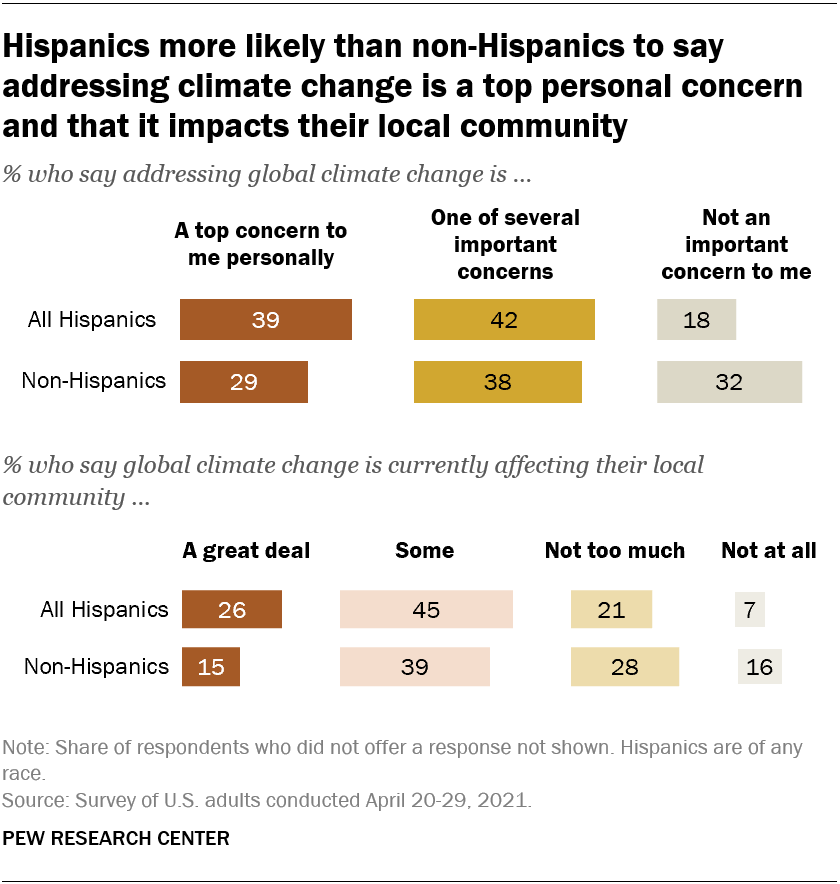
The survey asked 13,749 U.S. adults about their views on the climate, energy and environmental issues. Of those respondents, 2,153 were Latinos. The survey found that 39% of Hispanics believed that addressing global climate change is a top concern. Forty-two percent have stated that global climate change is one of several important concerns.
Maritza Darling-Ramos, 24, is an activist that resides in the East Side neighborhood in Chicago. She protested the move of a metal recycling facility, known as General Iron, into her neighborhood through a hunger strike in February 2021. According to the U.S. Environmental Protective Agency (EPA), the majority Latino neighborhood has been “environmentally overburdened” over the years.
The survey also found that 67% of non-Hispanics and 81% of Hispanics said climate change and environmental issues are an important or one of many important concerns.
Darling-Ramos said the discrepancy in the survey could be due to non-Hispanics not having to deal with environmental issues in their own neighborhoods. “I feel like they live in neighborhoods that don’t have that much pollution, so they don’t have to worry about it. If there is heavy truck traffic, it’s nowhere near the houses, so they just they don’t think it’s a big thing,” she said.
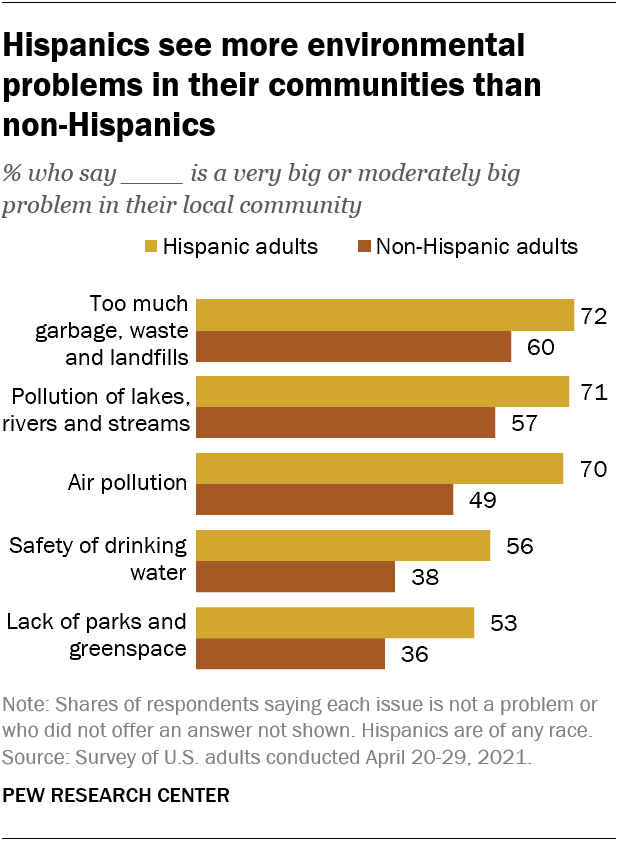
Hispanics said they felt they faced more environmental issues in their community than non-Hispanics in the Pew Research survey. For example, when asked about air pollution, 70% of Hispanics said that it was an environmental issue in their community compared to the 49% of non-Hispanics that said it was not.
Alfredo Hernandez, 30, is another resident of the East Side neighborhood that is aware of pollution in his community. “Our neighborhood has had a history with steel mills and pollution. The quality of the water at our local beach has deteriorated from trash and polluted water being dumped into Lake Michigan,” he said.
A 2021 data book published by conversancy group Alliance for the Great Lakes found that residents of this region faced “disproportionate health outcomes” compared to the rest of Chicago. Many residents experienced higher rates of coronary heart disease and chronic obstructive pulmonary disease, known as COPD.
“I have asthma,” Darling-Ramos said. “I think I’ve gotten it because I’ve lived out here, and there’s a lot of heavy traffic out here in the neighborhood.”
Hernandez has had similar adverse health experiences. “I feel that when I first moved into the area, I would be more sensitive to illness due to my immune system adjusting to the lower quality air,” he said. “One of my older neighbors has complained about coughing up black material occasionally.”
Hernandez agrees that protecting the environment is an important concern that should be addressed. “Nature is beautiful, and I think we take it for granted,” Hernandez said. “I’ve noticed less bumble bees and butterflies in my area. It’s a worrying sign of changes we might not see.”
For Darling-Ramos, her activism is a means to protect her home. “It’s the neighborhood I grew up in,” she said. “I want to make the neighborhood better.”
Data Citation: “Most U.S. Latinos say global climate change and other environmental issues impact their local communities.” Pew Research Center, Washington, D.C. (October 4, 2021) https://pewrsr.ch/3l8dRVG
Pew Research Center bears no responsibility for the analyses or interpretations of the data presented here. The opinions expressed herein, including any implications for policy, are those of the author and not of Pew Research Center.
Article written for a journalism course at University of Illinois at Urbana-Champaign
 Daniel Villarreal